Enjoy~
Tiny White Flowers

Saturday, March 21, 2009
Air. J.S. Bach, Bobby McFerrin
I've always loved this one, and enjoyed hearing Bobby McFerrin years ago on Prairie Home Companion.


Thursday, March 19, 2009
Kafka's Watch, a poem by Raymond Carver
On October 21, 1985, The New Yorker published this poem by Raymond Carver: Kafka’s Watch I have a job with a tiny salary of 80 crowns, and an infinite eight to nine hours of work. I devour the time outside of the office like a wild beast. Someday I hope to sit in a chair in another country, looking out the window at fields of sugarcane or Mohammedan cemeteries. I don’t complain about the work so much as about the sluggishness of swampy time. The office hours cannot be divided up! I feel the pressure of the full eight or nine hours even in the last half hour of the day. It’s like a train ride lasting night and day. In the end you’re totally crushed. You no longer thing about the straining of the engine, or about the hills or flat country, but ascribe all that’s happening to your watch alone. The watch which you continually hold in the palm of your hand. Then shake. And bring slowly to your ear in disbelief. To a devoted Carver fan, the poem seemed uncharacteristic: more lush than the spare style that tagged Carver as “minimalist.” I loved the poem, clipped it, and committed it to memory. Ten years later while reading Kafka’s letters, I came across this passage, written in October 1907, when Kafka was 24 and had begun work for the Italian insurance company Assicuraziono Generali: I am in the Assicurazioni Generali and have some hopes of someday sitting in chairs in faraway countries, looking out of the office windows at fields of sugar cane or Mohammedan cemeteries; and the whole world of insurance itself interests me greatly, but my present work is dreary. I don’t complain about the work so much as about the sluggisheness of swampy time. The office hours, you see, cannot be divided up; even in the last half hour I feel the pressure of the eight hours just as much as in the first. Often it is like a train ride lasting night and day, until in the end you’re totally crushed; you no longer think about the straining of the engine, or about the hilly or flat countryside but ascribe all that’s happening to your watch alone, which you continually hold in your palm . . . This is from the Best American Poetry Site: http://thebestamericanpoetry.typepad.com/the_best_american_poetry/2008/07/what-would-kafk.html
JULY 11, 2008
What Would Kafka Do?
 My life is completely chaotic now. At any rate, I have a job with a tiny salary of 80 crowns and an immense eight to nine hours of work; but I devour the hours outside the office like a wild beast. Since I was not previously accustomed to limiting my private life to six hours, and since I am also studying Italian and want to spend the evenings of these lovely days out of doors, I emerge from the crowdedness of my leisure hours scarcely rested . . .
My immediate reaction was dismay. Although I'm well acquainted with collage techniques and the practice of "sampling" -- as Eliot remarked, "immature poets imitate, mature poets steal" -- I wondered about the propriety of what RC had done. Did he take too many liberties? Does the title indicate that this is a “found” poem? When Carver later publishedKafka’s Watch in a collection, he added the epigraph “from a letter.” Does that addition make it right?
Would Kafka approve? Do you?
-- sdh
MIdnight note, 19 March 09
Truly a weird evening. I've been trying so hard for days to not get sick. DH got it first, and was sofa-bound for eleven whole days, which for him, is unheard of. DS got it three days later, and missed four days of school. DD and I finally began to get twinges of it by Sunday last. So far, DD is holding out the best, and isn't suffering any real ill effects. I, however, am still up, after trying to go to bed four hours ago. It seems I'm prone to coughing each time I try to lie down. So, after moving downstairs to the sofa, fitting it out with sheets and a pillow from the bed upstairs, doing the crossword - both the Warm-Up and the finishing touches on DH's NY Times one - and a cup of hot chocolate (inspired by something I *thought* I gleaned from one of the Down clues), here I am, still up.
Last night wasn't a whole lot better, except for the fact that I was able to fall asleep around ten. But I awoke at 2:30, 3ish, and 5:30 or so, only to be woken up by the 6:40 alarm. But I did have a wonderfully weird dream, much of which I attribute to reading too much Kafka during the day, and too many different home remedies and cups of tea. The last story I read in the collection was "The Country Doctor," a truly disturbing tale written in a very dreamlike way. I love Kafka's masterful way of weaving a compelling story in such a nightmarish fashion.
So, next thing I knew, DH and I were dancing at my dead Grandmother's (DM's mother's) house. There was a party going on, everything was lit, and the living room was very familiar, with the sofa just under the front window, next to the door, the chair between the entryway to the kitchen and the doorway to the downstairs bedroom, another love seat sofa at an angle to the corner, in front of a hutch, to the right of the door to the stairway leading up to the loft bedrooms. I really don't know who else was there - and there were people there; it was that kind of atmosphere - I just remember dancing with DH. I'm pretty sure it was dark outside, but it could have been light. It's just the sense I got; dancing in the evening.
Of course I wasn't the least surprised to be in the bathroom (not one in DG's house, but a very different, larger one). It was very open, with a stall in the middle of it, the toilet paper holder attached to the outer frame, just in front. No door, of course, and the paper in the holder was the width of printer paper; in fact, it was an on-going roll of snippets from a manuscript. I had to go, but I was also interested in what was written on the paper roll.
While I was settling in for a good read, a man walked in, an old man in ragged clothes. I was only slightly perturbed, for it was the women's bathroom, but he asked to be allowed to stay and use it, and I didn't refuse him that request. Rather, I found myself devising a way to pull my garments up and stand in one swift movement so as not to expose myself to him. But when I looked up, he'd taken off his rags, and (while I was planning my bid for modesty) turned into a woman, blond, youngish, and not altogether remarkable. And soon, other men wandered in through two other doors opposite the stall, and this room ceased to be a "women's room."
Somewhere in all of this I noticed a rather large and interesting poster on a wall depicting a Lego town, and was becoming intrigued with it's detailed yellow coastline, determined to take it home (wherever that was) because it would be the perfect size for my wall.
___________________________________
So, no gaping wounds, no travels through the snow lead by mysteriously appearing horses, no total nakedness, no attacks on my housemaid. Just another dream where men turn into women, I misplace my husband, and I find myself once again in a very large bathroom, this time with only one toilet.
___________________________________
Friday, March 6, 2009
Playing with Words
I found this very interesting. As I'm feeling less than creative right now, I'm perusing the creativity of others. . .
"I began to play with words then. I was a little obsessed by words of equal value.
Picasso was painting my portrait at that time, and he and I used to talk this thing
over endlessly. At this time he had just begun on cubism. . . . I took individual
words and thought about them until I got their weight and volume complete and
put them next to another word, and at this same time I found out very soon that
there is no such thing as putting them together without sense. I made innumerable
efforts to make words write without sense and found it impossible. Any human
being putting down words had to make sense out of them. . . . It should create
a satisfaction in the mind of the reader but in the same image as the creation."
- Gertrude Stein (A Transatlantic Interview—1946.)
A Primer for the Gradual Understanding of Gertrude Stein.
Edited by Robert Bartlett Haas.
eratiopostmodernpoetry
Crop Circles
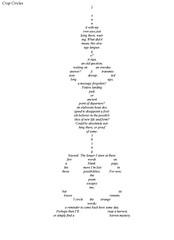
(Author has granted permission for users to download this poem for viewing on other sites but asks that a link to Author's site mentioned in profile be included.)
Here is the poem, a little larger:
Waiting on a poem
This is another look at the poet at work, composing for passersby. Love it!
"Again, the photo note reads:
This guy was sitting on a street corner. We passed by him and he asked, "Can I write you guys a poem?" We politely refused, but as we kept walking each of us began to consider it, and we turned around to walk back to him. He asked what we'd like a poem about, and we explained that we were on a weekend trip. He tore off a little piece of paper from something in his bag, and began typing. We asked him to read it to us, which he did, after commenting that no one ever asked him to read his poems after composing them. He was in New Orleans for a few weeks, but had previously been a street corner poet in San Francisco while in school there.
We still have the poem, of course, but I'll have to wait until after spring break to scan and upload it here. We paid him five dollars."

"Again, the photo note reads:
This guy was sitting on a street corner. We passed by him and he asked, "Can I write you guys a poem?" We politely refused, but as we kept walking each of us began to consider it, and we turned around to walk back to him. He asked what we'd like a poem about, and we explained that we were on a weekend trip. He tore off a little piece of paper from something in his bag, and began typing. We asked him to read it to us, which he did, after commenting that no one ever asked him to read his poems after composing them. He was in New Orleans for a few weeks, but had previously been a street corner poet in San Francisco while in school there.
We still have the poem, of course, but I'll have to wait until after spring break to scan and upload it here. We paid him five dollars."
Poems for sale
I love this!!! I wish I could write a poem on demand, but alas, it doesn't work that way for me~
Here is the note that goes with the photo:
"Poems for sale
This guy was sitting on a street corner. We passed by him and he asked, "Can I write you guys a poem?" We politely refused, but as we kept walking each of us began to consider it, and we turned around to walk back to him. He asked what we'd like a poem about, and we explained that we were on a weekend trip. He tore off a little piece of paper from something in his bag, and began typing. We asked him to read it to us, which he did, after commenting that no one ever asked him to read his poems after composing them. He was in New Orleans for a few weeks, but had previously been a street corner poet in San Francisco while in school there.
We still have the poem, of course, but I'll have to wait until after spring break to scan and upload it here. We paid him five dollars."


Here is the note that goes with the photo:
"Poems for sale
This guy was sitting on a street corner. We passed by him and he asked, "Can I write you guys a poem?" We politely refused, but as we kept walking each of us began to consider it, and we turned around to walk back to him. He asked what we'd like a poem about, and we explained that we were on a weekend trip. He tore off a little piece of paper from something in his bag, and began typing. We asked him to read it to us, which he did, after commenting that no one ever asked him to read his poems after composing them. He was in New Orleans for a few weeks, but had previously been a street corner poet in San Francisco while in school there.
We still have the poem, of course, but I'll have to wait until after spring break to scan and upload it here. We paid him five dollars."
Saturday, February 28, 2009
Midnight note, 28 Feb. 09
I'm thinking about all the doodling I did in college. . . my brain must be in great shape! Well, looking back, perhaps this is why I was always good at remembering things my DM couldn't remember, which bugged her no end.
Take Note: Doodling Can Help Memory

By HealthDay - Fri Feb 27, 8:48 PM PST
Researchers in the United Kingdom found that test subjects who doodled while listening to a recorded message had a 29 percent better recall of the message's details than those who didn't doodle. The findings were published inApplied Cognitive Psychology.
"If someone is doing a boring task, like listening to a dull telephone conversation, they may start to daydream," study researcher Professor Jackie Andrade, of the School of Psychology at the University of Plymouth, said in a news release issued by the journal's publisher. "Daydreaming distracts them from the task, resulting in poorer performance. A simple task, like doodling, may be sufficient to stop daydreaming without affecting performance on the main task."
For the experiment, a two-and-a-half minute listing of several people's names and places was played for test subjects, who were charged with writing down only the names of the people said to be attending a party. During the recording, half the participants were asked to simultaneously shade in shapes on a piece of paper without attention to neatness. Participants were not told they were taking part in a memory test.
When the recording ended, all were asked for the eight names of those attending the party as well as eight place names mentioned in the audio. Those asked to doodle wrote down, on average, 7.5 names and places, while those who didn't doodle listed only 5.8.
"In psychology, tests of memory or attention will often use a second task to selectively block a particular mental process," Andrade said. "If that process is important for the main cognitive task, then performance will be impaired. My research shows that beneficial effects of secondary tasks, such as doodling, on concentration may offset the effects of selective blockade."
In everyday life, Andrade said, doodling "may be something we do because it helps to keep us on track with a boring task, rather than being an unnecessary distraction that we should try to resist doing."
More information
The AARP has more about memory.
Friday, February 27, 2009
Subscribe to:
Posts (Atom)
LinkWithin
