
Detail of a Dia de los Muertos painting of Frida in the Hollywood Forever mausoleum.
Tiny White Flowers

Saturday, October 31, 2009


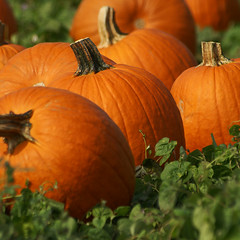
The Pumpkin Patch 2007
I'm having a great time looking up fun Halloween photos:
note:
"As we can see from last year's Pumpkin Patch, we have grown a bit this year, thanks to after Halloween clearance sales."

note:
"As we can see from last year's Pumpkin Patch, we have grown a bit this year, thanks to after Halloween clearance sales."
tucker pumpkin costume cat
If you are bored, and your cat is, too, here is an idea:
photo note:
"Tucker loved his pumpkin costume...well in truth he had to be baited with some turkey. I started to take the red eye off him but left it as I liked it with the colors of the chair and his costume"

photo note:
"Tucker loved his pumpkin costume...well in truth he had to be baited with some turkey. I started to take the red eye off him but left it as I liked it with the colors of the chair and his costume"
Welcome Great Pumpkin
"There are three things I have learned never to discuss with people: religion, politics, and the Great Pumpkin."
(Linus in the Peanuts’ “It’s the great Pumpkin, Charlie Brown”)
(Linus in the Peanuts’ “It’s the great Pumpkin, Charlie Brown”)
Thursday, October 29, 2009
Inviting a Friend to Dinner
(After Ben Johnson)
When you are next in town, I would be honored, sir,
if you would dine with me. I have a small place,
a little shabby perhaps, but cosy. The lamps
glow soft and warm, and with the curtains drawn,
you’d think you were in some New York or Paris bistro.
I would serve you something humble first,
home-made hummus, say, with warmed bread,
salad from the local farmer’s market, tasty
green beans, roast chicken, with peach
and honey sauce, rice—and wine, of course.
For dessert, I would offer my apple pie with cream.
And I would have Schubert playing, something quiet and sweet,
with a touch of sadness, to remind us of all life’s delicacies.
And I could read to you, or sing, or we could both sing,
or you could recite poems over cognac or coffee or tea.
And we could talk, of extraordinary or ordinary things.
For there is something to be said for the quiet, daily ritual
of breaking bread, for the discussion a meal engenders—
nothing fancy, neither food nor talk, just the old
stories, the old good-natured teasing between friends.
I don’t think Horace or Homer and his Odysseus
would disagree that at such moments people
are at their best, that spirited conversation over lunch,
or dinner or tea, or even breakfast, may be the essence
of humanity. Sir, let’s put this theory to the test.
--Charlotte Innes
When you are next in town, I would be honored, sir,
if you would dine with me. I have a small place,
a little shabby perhaps, but cosy. The lamps
glow soft and warm, and with the curtains drawn,
you’d think you were in some New York or Paris bistro.
I would serve you something humble first,
home-made hummus, say, with warmed bread,
salad from the local farmer’s market, tasty
green beans, roast chicken, with peach
and honey sauce, rice—and wine, of course.
For dessert, I would offer my apple pie with cream.
And I would have Schubert playing, something quiet and sweet,
with a touch of sadness, to remind us of all life’s delicacies.
And I could read to you, or sing, or we could both sing,
or you could recite poems over cognac or coffee or tea.
And we could talk, of extraordinary or ordinary things.
For there is something to be said for the quiet, daily ritual
of breaking bread, for the discussion a meal engenders—
nothing fancy, neither food nor talk, just the old
stories, the old good-natured teasing between friends.
I don’t think Horace or Homer and his Odysseus
would disagree that at such moments people
are at their best, that spirited conversation over lunch,
or dinner or tea, or even breakfast, may be the essence
of humanity. Sir, let’s put this theory to the test.
--Charlotte Innes
That Evening at Dinner by David Ferry
A "dinner" poem, and a different experience.
That Evening at Dinner by David Ferry : The Poetry Foundation [poem] : Find Poems and Poets. Discover Poetry.
That Evening at Dinner by David Ferry : The Poetry Foundation [poem] : Find Poems and Poets. Discover Poetry.
That Evening at Dinner
By the last few times we saw her it was clear
That things were different. When you tried to help her
Get out of the car or get from the car to the door
Or across the apartment house hall to the elevator
There was a new sense of heaviness
Or of inertia in the body. It wasn’t
That she was less willing to be helped to walk
But that the walking itself had become less willing.
Maybe the stupid demogorgon blind
Recalcitrance of body, resentful of the laws
Of mind and spirit, was getting its own back now,
Or maybe a new and subtle, alien,
Intelligence of body was obedient now
To other laws: “Weight is the measure of
The force with which a body is drawn downward
To the center of the earth”; “Inertia is
The tendency of a body to resist
Proceeding to its fate in any way
Other than that determined for itself.”
That evening, at the Bromells’ apartment, after
She had been carried up through the rational structure
By articulate stages, floor after flashing floor,
And after we helped her get across the hall,
And get across the room to a chair, somehow
We got her seated in a chair that was placed
A little too far away from the nearest table,
At the edge of the abyss, and there she sat,
Exposed, her body the object of our attention—
The heaviness of it, the helpless graceless leg,
The thick stocking, the leg brace, the medical shoe.
At work between herself and us there was
A new principle of social awkwardness
And skillfulness required of each of us.
Our tones of voice in this easy conversation
Were instruments of marvelous finesse,
Measuring and maintaining with exactitude
“The fact or condition of the difference
There was between us, both in space and time.”
Her smiling made her look as if she had
Just then tasted something delicious, the charm
Her courtesy attributed to her friends.
This decent elegant fellow human being
Was seated in virtue, character, disability,
Behind her the order of the ranged bookshelves,
The windows monitored by Venetian blinds—
“These can be raised or lowered; numerous slats,
Horizontally arranged, and parallel,
Which can be tilted so as to admit
Precisely the desired light or air.”
We were all her friends, Maggie, and Bill, and Anne,
And I, and the nice Boston Brahmin elderly man
Named Duncan, utterly friendly and benign.
And of course it wasn’t whether or not the world
Was benign but whether it looked at her too much.
She wasn’t “painfully shy” but just the same
I wouldn’t be surprised if there had been
Painfulness in her shyness earlier on,
Say at dancing school. Like others, though, she had
Survived her childhood somehow. Nor do I mean
She was unhappy. Maybe more or less so
Before her marriage. One had the sense of trips
Arranged, committees, concerts, baffled courage
Living it through, giving it order and style.
And one had the sense of the late marriage as of
Two bafflements inventing the sense they made
Together. The marriage seemed, to the outside world,
And probably was, radiant and triumphant,
And I think that one could almost certainly say
That during the last, heroic, phase of things,
After his death, and after the stroke, she had
By force of character and careful management,
Maintained a certain degree of happiness.
The books there on the bookshelves told their stories,
Line after line, all of them evenly spaced,
And spaces between the words. You could fall through the spaces.
In one of the books Dr. Johnson told the story:
“In the scale of being, wherever it begins,
Or ends, there are chasms infinitely deep;
Infinite vacuities ... For surely,
Nothing can so disturb the passions, or
Perplex the intellects of man so much,
As the disruption of this union with
Visible nature, separation from all
That has delighted or engaged him, a change
Not only of the place but of the manner
Of his being, an entrance into a state
Not simply which he knows not, but perhaps
A state he has not faculties to know.”
The dinner was delicious, fresh greens, and reds,
And yellows, produce of the season due,
And fish from the nearby sea; and there were also
Ashes to be eaten, and dirt to drink.
Dinner Guest: Me by Langston Hughes
Okay, while this in no way reflects our wonderful evening last night, it *is* a poem about being a dinner guest. . .
Dinner Guest: Me by Langston Hughes
Dinner Guest: Me by Langston Hughes
Dinner Guest: Me
I know I am
The Negro Problem
Being wined and dined,
Answering the usual questions
That come to white mind
Which seeks demurely
To Probe in polite way
The why and wherewithal
Of darkness U.S.A.--
Wondering how things got this way
In current democratic night,
Murmuring gently
Over fraises du bois,
"I'm so ashamed of being white."
The lobster is delicious,
The wine divine,
And center of attention
At the damask table, mine.
To be a Problem on
Park Avenue at eight
Is not so bad.
Solutions to the Problem,
Of course, wait.
Langston Hughes
Wednesday, October 28, 2009
It must be Wednesday. . .

And it was. Now it's Thursday. It seems the post I never made made its way into publication. And for that, I apologize.
Yesterday was a full day, with a friend from two states away coming to visit. We sat by the woodstove and talked and caught up as best as three can, and I broke away into the kitchen, only feet away, to make dinner: roast beef pan-browned with onion and peppercorns, then oven-baked in chicken broth. Very simple. I would however, have added a bay leaf to the pot, and some cloves of garlic, but I was out of garlic (a crime, I know), and didn't want to disturb the conversation by going outside to pick the bay leaf. It was still pretty tasty, in all its simple-ness.
To go with, we had mashed potatoes and oven-baked acorn squash, with a pat of butter added half way through, and a touch of brown sugar on each half, near the end of the baking. And while I created a gravy from the juice of the roast, the asparagus steamed.
> My method for making gravy: Mix melted butter and flour in a measuring cup until well blended. Since I had no fat drippings in the roast pan (having cooked it in chicken broth): Add little by little some of the juice from the roast pot, then pour into a warm skillet. I sometimes pour this roux-of-sorts through a strainer in case there are still some solids, and this for me prevents lumps in the gravy. Finish in the pan as normal.
* * *
So while this was going on, the fire was heating the house, it began to rain, and the pumpkin breads cooled on the counter. And a sure-fire method for not-worrying about the doneness of the roast? Sit down to a slide show of a recent Alaska trip/cruise. By then end of that, the asparagus can steam while the potatoes are mashed and the gravy made. The roast was done. We sat down to eat, and the evening was good.
* * *
I said on Facebook yesterday that I need more time. I am becoming antsy about writing more, and am thankful that this year's Poem-A-Day challenge is nearing. The month of November one writes a poem a day - or - by the last day of November, one has a poem for every day of the month. Loosely translated: one might not actually write a poem every day, but one makes up for it on other days. Like Lent, this is incentive to write daily. (I have used Lent as a time to take on daily writing if I haven't been good about it, and the work often draws from what's going on during that time, especially as we head into Holy Week.)
* * *
I didn't post my Wednesday poem, so I'll go looking for one, and it'll show up soon enough. Think of it as a bonus for today, a way to lengthen the love. In my family birthdays are celebrated on the day, but the bigger celebrations were held on Sundays, and sometimes a party on Saturday as well. I think Birthday Week is a better way to handle the situation, making sure you include everyone.
It's fall today, with rain and wind and leaves leaving trees. It's Thursday, and I'm off now to find a poem.
Note: this post is doing double duty, appearing also on Nourishing Words, Beautiful Food.
Monday, October 26, 2009
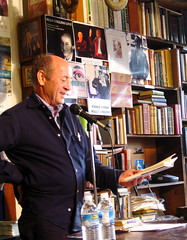
Billy Collins at D.G. Wills
Okay, this is totally random. I have a purse blog, And the Bag to Match, and I was looking up Dolce & Gabbana bags, but typed in D&G, and found this. I've seen Billy Collins twice, but from a back 40 bleacher seat in a high school gymnasium. I think this might have been a little more intimate!
Here's what this photographer has to say:
Here's what this photographer has to say:
Billy Collins at D.G. Wills
Poetry Reading at D.G. Wills Books - La Jolla, CA - October 19, 2008
Here's an article in today's paper about how Dennis was able to talk Billy Collins into coming to the bookstore:
tinyurl.com/5sr87a
Sunday, October 25, 2009
Lord Byron
Photo note:
"19th century --- Chromolithograph of Lord Byron --- Image by © Chris Hellier/Corbis"
And from Wordsmith: A Word A Day
http://wordsmith.org/words/byronic.html
This week's theme
Eponyms
This week's words:
byronic
Lord Byron
A.Word.A.Day
with Anu Garg
"Proper names that have become improper and uncommonly common" is how the author Willard R. Espy described eponyms, and that is the theme for this week's words in AWAD: words coined after people's names.
We are going to meet a poet, a novelist, a prophet, a statesman, and a legislator. They wrote poems, novels, holy books, political treatises, and laws.
In our quest for eponyms, we are going to visit England, Persia, Italy, and Greece. All aboard!
Byronic
PRONUNCIATION:
(by-RON-ik)
MEANING:
adjective: One who is melancholic, passionate, and melodramatic, and disregards societal norms.
ETYMOLOGY:
After poet Lord Byron (1788-1824), who displayed such characteristics, as did his poetry, i.e. a flawed character marked by great passion who exhibits disrespect for social institutions and is self-destructive.
NOTES:
A little-known fact: He was the father of Ada Lovelace, today known as the first computer programmer, who wrote programs for Charles Babbage's analytical engine.
USAGE:
"Zenovich casts [movie director Roman] Polanski, whose face repeatedly fills the screen with a Byronic luminosity, as a tragic figure, a child survivor of the Holocaust haunted by the murder of his wife, the actress Sharon Tate, at the hands of the Manson family."
Bill Wyman; Whitewashing Roman Polanski; Salon (New York); Feb 19, 2009.
"Laurie may have his pet theories as to why [Gregory] House-the-character has become a cult -- the damaged, Byronic genius/healer who can say the unsayable and (almost always) get away with it."
Stuart Husband; Hugh Laurie Interview; The Daily Telegraph (London, UK); Jun 3, 2009.
A THOUGHT FOR TODAY:
You talk when you cease to be at peace with your thoughts. -Khalil Gibran, mystic, poet, and artist (1883-1931)

"19th century --- Chromolithograph of Lord Byron --- Image by © Chris Hellier/Corbis"
And from Wordsmith: A Word A Day
http://wordsmith.org/words/byronic.html
This week's theme
Eponyms
This week's words:
byronic
Lord Byron
A.Word.A.Day
with Anu Garg
"Proper names that have become improper and uncommonly common" is how the author Willard R. Espy described eponyms, and that is the theme for this week's words in AWAD: words coined after people's names.
We are going to meet a poet, a novelist, a prophet, a statesman, and a legislator. They wrote poems, novels, holy books, political treatises, and laws.
In our quest for eponyms, we are going to visit England, Persia, Italy, and Greece. All aboard!
Byronic
PRONUNCIATION:
(by-RON-ik)
MEANING:
adjective: One who is melancholic, passionate, and melodramatic, and disregards societal norms.
ETYMOLOGY:
After poet Lord Byron (1788-1824), who displayed such characteristics, as did his poetry, i.e. a flawed character marked by great passion who exhibits disrespect for social institutions and is self-destructive.
NOTES:
A little-known fact: He was the father of Ada Lovelace, today known as the first computer programmer, who wrote programs for Charles Babbage's analytical engine.
USAGE:
"Zenovich casts [movie director Roman] Polanski, whose face repeatedly fills the screen with a Byronic luminosity, as a tragic figure, a child survivor of the Holocaust haunted by the murder of his wife, the actress Sharon Tate, at the hands of the Manson family."
Bill Wyman; Whitewashing Roman Polanski; Salon (New York); Feb 19, 2009.
"Laurie may have his pet theories as to why [Gregory] House-the-character has become a cult -- the damaged, Byronic genius/healer who can say the unsayable and (almost always) get away with it."
Stuart Husband; Hugh Laurie Interview; The Daily Telegraph (London, UK); Jun 3, 2009.
A THOUGHT FOR TODAY:
You talk when you cease to be at peace with your thoughts. -Khalil Gibran, mystic, poet, and artist (1883-1931)
Subscribe to:
Posts (Atom)
LinkWithin
