Today's poem on Poets.org:
9773 Comanche Ave.
by David Trinidad
In color photographs, my childhood house looks
fresh as an uncut sheet cake—
pale yellow buttercream, ribbons of white trim
squeezed from the grooved tip of a pastry tube.
Whose dream was this confection?
This suburb of identical, pillow-mint homes?
The sky, too, is pastel. Children roller skate
down the new sidewalk. Fathers stake young trees.
Mothers plan baby showers and Tupperware parties.
The Avon Lady treks door to door.
Six or seven years old, I stand on the front porch,
hand on the decorative cast-iron trellis that frames it,
squinting in California sunlight,
striped short-sleeved shirt buttoned at the neck.
I sit in the backyard (this picture's black-and-white),
my Flintstones playset spread out on the grass.
I arrange each plastic character, each dinosaur,
each palm tree and round "granite" house.
Half a century later, I barely recognize it
when I search the address on Google Maps
and, via "Street view," find myself face to face—
foliage overgrown, facade remodeled and painted
a drab brown. I click to zoom: light hits
one of the windows. I can almost see what's inside.
Tiny White Flowers

Tuesday, September 28, 2010


Thursday, September 16, 2010
Paper Cranes
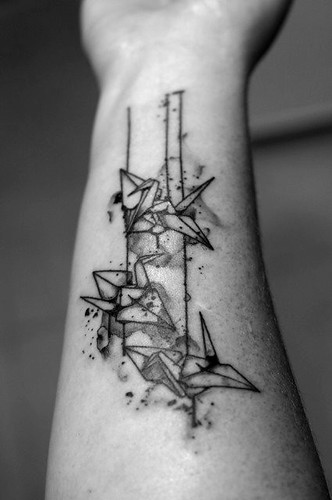
I'm looking up images tagged with the word leukemia, which is what my dad has.
Photo note:
"Art by: Nanami Cowdroy
Tattoo by: Rian (Cold Steel America)
Tsuru: The Japanese Crane
Throughout history, birds have been viewed as animals of special value and have been endowed with meanings often drawn from legends and stories that have endured over many generations.
For the Japanese, the crane—or tsuru—is considered a national treasure, appearing in art, literature, and folklore. The Japanese regard the crane as a symbol of good fortune and longevity because of its fabled life span of a thousand years. It also represents fidelity, as Japanese cranes are known to mate for life. Over time, the crane has also evolved as a favorite subject of the Japanese tradition of paper folding—origami—as children and adults attempt to master this art.
Shortly after the end of World War II, the folded origami cranes came to symbolize a hope for peace through Sadako Sasaki and her unforgettable story of perseverance. Diagnosed with leukemia after being exposed to radiation after the bombing of Hiroshima, Sadako became determined to reach a goal of folding 1,000 cranes in hopes of being rewarded with health, happiness, and a world of eternal peace. Although she died before reaching her goal, the tradition of sending origami cranes to the Hiroshima memorial has endured as a symbol of the Japan’s ongoing wish for nuclear disarmament and world peace.
Yay [explore - Jul 30, 2009 #81]"
Wednesday, September 15, 2010
Tree by Richard Jones
Tree by Richard Jones
| ||
|
Saturday, September 11, 2010
Remember~

Verse Daily: Letter to the End of the Year by Susan Rich
Today's poem on verse daily is by Susan Rich, and it is wonderful. Great job, Susan!
Below is the link to Verse Daily, and Susan's poem:
Verse Daily: Letter to the End of the Year by Susan Rich
Below is the link to Verse Daily, and Susan's poem:
Verse Daily: Letter to the End of the Year by Susan Rich
Friday, September 10, 2010
Amazing Grace History/"Amazing Grace" By Wintley Phipps
Today has been a good day for music discoveries.
Understand that it really doesn't matter what color, religion, persuasion we are, this is just good, inclusive stuff, and it just goes directly to the heart.
Enjoy~
Understand that it really doesn't matter what color, religion, persuasion we are, this is just good, inclusive stuff, and it just goes directly to the heart.
Enjoy~
Johnny Cash - Nine Inch Nails - "Hurt"
I've been surfing music this morning. First, it was the song "I Shall Not Walk Alone," sung by the Blind Boys of Alabama. And, as my daughter and her friend were playing my Johnny Cash CD Hurt, I did a little more digging around, listening to the Nine Inch Nails (original) as well, and also found this note:
* * *
This is from Songfacts:
"Trent Reznor has confessed that originally he was angry that Johnny Cash had covered this, as it was such a personal song to him. However, once he heard Cash's heart-wrenching version and saw the poignant video, he changed his tune.
Reznor recalled to The Sun Newspaper August 1st 2008: "The Cash thing was a couple of years into being clean I was very unsure of myself. Did I have anything to say? Could I still write music? Did anyone still care? I'd been out of the limelight for a while. I'd put the brakes on everything to try to get my life in order, to try to get healthy and stay alive. I'd been friends with Rick Rubin for several years. He called me to ask how I'd feel if Johnny Cash covered Hurt. I said I'd be very flattered but was given no indication it would actually be recorded. Two weeks went by. Then I got a CD in the post. I listened to it and it was very strange. It was this other person inhabiting my most personal song. I'd known where I was when I wrote it. I know what I was thinking about. I know how I felt. Hearing it was like someone kissing your girlfriend. It felt invasive."
It was when Reznor finally saw the video that his attitude changed. He continued: "It really, really made sense and I thought what a powerful piece of art. I never got to meet Johnny but I'm happy I contributed the way I did. It felt like a warm hug. For anyone who hasn't seen it, I highly recommend checking it out. I have goose bumps right now thinking about it." "
* * *
So, from an artistic standpoint, I find both of these versions intriguing, and disturbing. And yes, deeply personal. There are several versions on Youtube of the Nine Inch Nails, two having many more views than the one I chose. I'm posting this one, because it is one that was used in concert, with images chosen by them. And that, to me, makes it all the more compelling.
* * *
This is from Songfacts:
"Trent Reznor has confessed that originally he was angry that Johnny Cash had covered this, as it was such a personal song to him. However, once he heard Cash's heart-wrenching version and saw the poignant video, he changed his tune.
Reznor recalled to The Sun Newspaper August 1st 2008: "The Cash thing was a couple of years into being clean I was very unsure of myself. Did I have anything to say? Could I still write music? Did anyone still care? I'd been out of the limelight for a while. I'd put the brakes on everything to try to get my life in order, to try to get healthy and stay alive. I'd been friends with Rick Rubin for several years. He called me to ask how I'd feel if Johnny Cash covered Hurt. I said I'd be very flattered but was given no indication it would actually be recorded. Two weeks went by. Then I got a CD in the post. I listened to it and it was very strange. It was this other person inhabiting my most personal song. I'd known where I was when I wrote it. I know what I was thinking about. I know how I felt. Hearing it was like someone kissing your girlfriend. It felt invasive."
It was when Reznor finally saw the video that his attitude changed. He continued: "It really, really made sense and I thought what a powerful piece of art. I never got to meet Johnny but I'm happy I contributed the way I did. It felt like a warm hug. For anyone who hasn't seen it, I highly recommend checking it out. I have goose bumps right now thinking about it." "
* * *
So, from an artistic standpoint, I find both of these versions intriguing, and disturbing. And yes, deeply personal. There are several versions on Youtube of the Nine Inch Nails, two having many more views than the one I chose. I'm posting this one, because it is one that was used in concert, with images chosen by them. And that, to me, makes it all the more compelling.
Wednesday, September 8, 2010
Subscribe to:
Posts (Atom)
LinkWithin
